



I remember standing in my kitchen at midnight, hunched over a glowing screen, weighing chicken breast like it was contraband.
Every spoon of rice. Every drop of oil. Every gram logged into an app like scripture.
I called it discipline.
It wasn’t discipline. It was a math problem I couldn’t win, and at the time I had no idea why.
Here’s the claim, stated carefully, because the careless version gets you laughed out of the room. The law of energy conservation still applies. Energy doesn’t vanish. But your body is not a sealed box. It is an open system, constantly trading energy and matter with the world, and constantly adjusting how much it absorbs and how much it spends based on what you do to it. That single fact is what destroys calorie counting.
In a sealed box with fixed inputs and fixed outputs, the math would work. Calories in minus calories out would predict the result every time. Your body has no fixed terms. Change what goes in and it changes what it pulls out of the food, what it stores, and what it burns, on its own, without consulting you or your app. The energy is always accounted for. The equation is just never the same equation twice. You are not breaking physics. You are trying to solve a problem whose numbers rewrite themselves the instant you act on them. That is not a problem discipline can fix.
Where the calorie actually came from
And while we’re being precise, here’s where the calorie actually came from, because it isn’t what the fitness industry implies. It was cooked up in a 19th-century laboratory to measure the heat a food gives off when you set it on fire. That’s the whole origin. A unit of energy, invented by chemists, never once meant to measure whether a food was good for a human being.
The food industry seized on it later, and you can see exactly why they loved it. A single number that ignores everything that matters about a food, its quality, its hormonal effect, what it does to your gut, is the perfect cover for selling garbage.
Put “low calorie” on a box of chemical sludge and it becomes a diet food. Stamp “lite” on the label and charge more for it. The calorie gave them a sciencey-sounding number that couldn’t tell the difference between a steak and a stack of cookies, as long as the totals matched.
It didn’t start as a marketing tool. It became the best one they ever found, because nothing serves a junk-food business better than a health measure that’s blind to health.
Your body is not a bank account
Two men can eat the same 2,000 calories and end up in completely different places.
One eats real food, front-loaded earlier in the day, with a regulated nervous system and a gut that absorbs what he gives it. The other eats the same number split across processed meals, late at night, under chronic stress, with a gut that’s inflamed. Same number on the app. Completely different hormonal instructions sent to the body about what to do with that food.
Calories tell you how much energy went in. They tell you nothing about whether your body will store it, burn it, build with it, or waste it. That decision is made by your hormones, your meal timing, your metabolic state, and the quality of what you ate. The calorie count is the one variable you can sort of see, which is exactly why people cling to it, and it’s the least informative one once the others are off.
The equation moves when you solve it
This is the part that makes it genuinely futile, not just imprecise.
When you eat less, your body does not passively burn the difference from your reserves. It adapts. It lowers the amount of energy it spends to match the amount coming in. Thyroid output drops. You move less without noticing, fidget less, take the elevator. Your metabolic rate quietly slides down to meet the new intake.
So you create a deficit. The body closes it by spending less. The scale stalls. You cut again. The body slows again. You are chasing a number that retreats as you approach it. This isn’t a theory built on one study. The long-term follow-up of severe dieters has shown metabolic rates suppressed well below what their body size predicts, and staying suppressed for years. The math you started with stopped being true the moment your body started defending itself.
A disciplined man hits this wall and concludes he needs more discipline. He needs a smaller number. So he cuts further, and the system slows further, and now he’s tired, losing muscle, sleeping badly, and holding fat harder than when he started. The framework told him the answer was less. His biology was telling him the framework was the problem.
Timing and quality change everything the count can’t see
The same calories don’t even behave the same way inside the same body at different times of day.
Eat a large meal late at night, under screens, and you get a sharper insulin response and a disrupted cortisol and melatonin rhythm than you’d get from the identical food eaten in the morning. Eat industrial seed oils and you load your cells with fragile, oxidation-prone fats that blunt how well your mitochondria produce energy. Eat real food and you get the opposite.
The app records all of these as the same entry. A late-night takeaway and a front-loaded plate of real food can log identical, and your body treats them as two entirely different instructions. You are tracking the one thing that stayed constant while ignoring everything that changed.
The hidden cost of living by the count
Even setting the futility aside, the tracking carries a price that usually makes the original goal harder.
Chronic restriction is a chronic stressor, and the monitoring is a stressor on top of it. Every meal becomes a math problem. Every bite a small decision to get right or wrong. That low-grade vigilance keeps the nervous system switched on, and a body that reads its environment as stressful and scarce does predictable things. It suppresses hormonal function, including testosterone. It becomes willing to break down muscle, which is metabolically expensive, to conserve. It downshifts the thyroid, so you feel cold, flat, and tired on fewer calories than before.
So the man doing everything “right” ends up softer, weaker, and more anxious about food than when he started, and the spreadsheet tells him he’s been compliant the whole time. He has been. That’s the cruelty of it. The compliance was never the issue.
The better model: stop managing the number, build the engine
The fix isn’t a smarter calorie target. It’s abandoning the target and building the conditions for your metabolism to run hot on its own.
Eat in rhythm with your biology. Two substantial real-food meals, front-loaded, the bulk of your intake in by mid-afternoon, with a light or absent dinner. This works with your cortisol and melatonin cycles instead of against them and keeps insulin sensitivity high.
Eat food that gives the body real instructions. Grass-fed meat, well-sourced seafood, root vegetables, raw dairy, seasonal fruit, and the saturated fats your hormones are built from. When the body is actually nourished, the cravings that drive late-night grazing fall away within weeks, because the cravings were a request for nutrients you weren’t providing.
Remove the industrial inputs. Seed oils, synthetic supplements, chemical sweeteners. They don’t just add to a number, they degrade the machinery the number can’t measure.
Then support the system from the outside the count never touches. Morning sunlight. Posture-centered strength work rather than grinding yourself into the ground. Genuine nervous system regulation. The unglamorous foundations beat any macro calculator, every time.
When the body feels safe and fed, it stops hoarding. It runs hot. You eat more, not less, and your body spends it instead of storing it. That is the engine you actually want, and you cannot get there by negotiating with an app.
The pattern I see
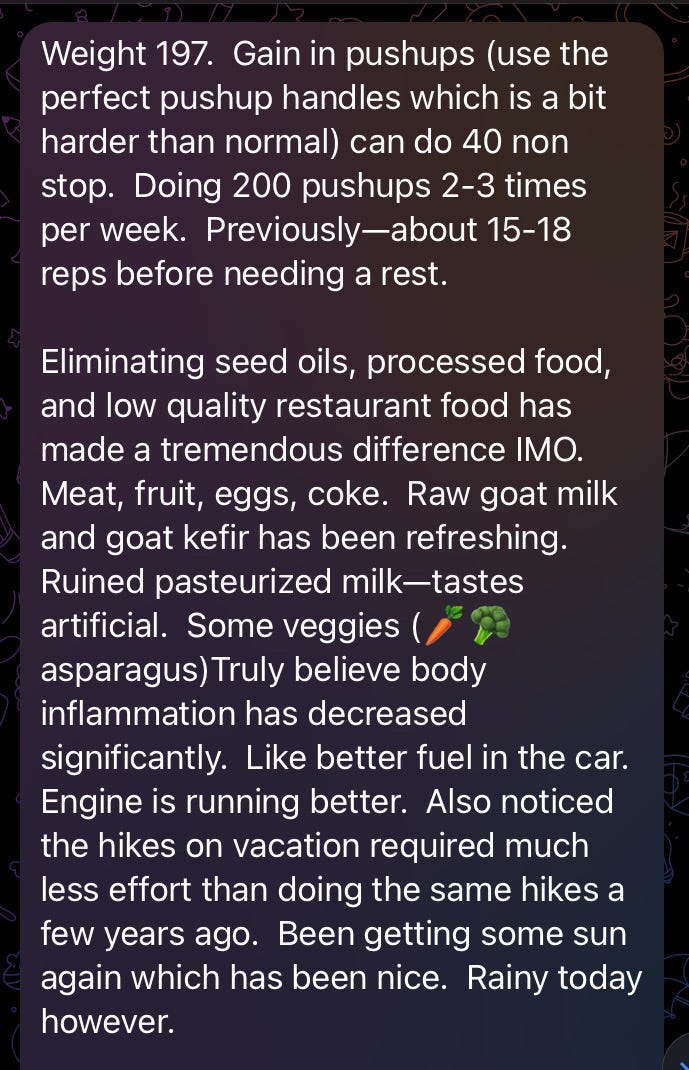
The fitness industry sells addition. Macros to track, calories to count, supplements to stack, and foods to eliminate. My 55 y/o business owner client, Travis Schmitt, removed three things and kept the coke, the fruit, and the raw goat milk. Pushups doubled, inflammation crashed, and now, he moves like a younger man by doing less, not more… and not counting a single calorie.
The close
You don’t want to burn calories. You want a metabolic engine that runs hot and hard without needing you to micromanage it.
Those are different goals, and the count actively works against the second one. It keeps your attention on the single variable that matters least once the foundations are off, while convincing you that effort is the missing ingredient. It never was. The numbers were always moving. The discipline was always real. The framework was always the wrong one.
Stop trying to win the math. Build the engine instead.
If you read this far and the thinking lands, the newsletter is where I write more of it.
1-2 emails a week on what calibration actually looks like for men over 40 who’ve stopped getting returns on effort alone. No apps to download, no macros to hit, no spreadsheet to worship. Just how the body actually works and how to stop fighting it.
Subscribe if you want it. Don’t if you don’t.
P.S. Not medical advice.