


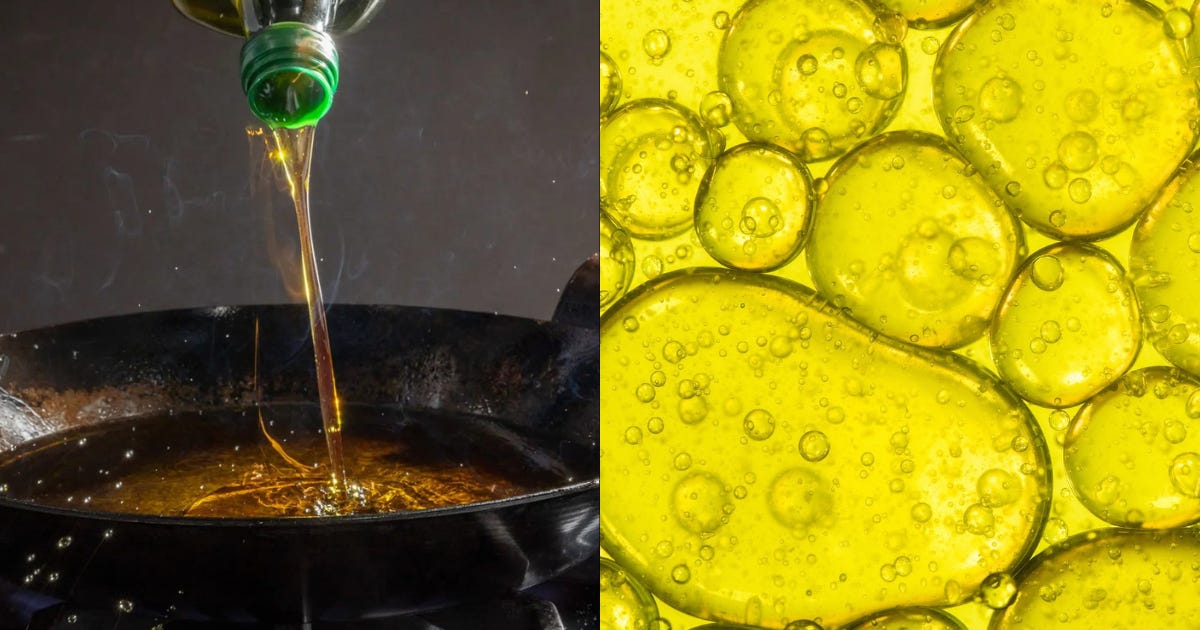
For a while I felt smug about my olive oil.
I’d grab the $8 bottle labeled extra virgin, drizzle it over my steak, and feel like I was doing the clean, simple, ancestral thing. Real food. No nonsense. One of the easy wins.
I was being played. You probably are too.
This was during the stretch after I beat cancer, when I threw myself into health with everything I had. Supplements, superfoods, every product that promised better hormones and more energy. Olive oil was a staple I never questioned. Everyone said it was healthy, so I trusted it, the same way I trusted everything else that arrived with a clean-sounding label. That blind trust is the part worth talking about, because the olive oil is just the clearest example of it.
Here is the uncomfortable thing. You cannot trust the inputs you assume are clean. You think you are doing the simple thing right. Meanwhile the supply chain has quietly turned one of your healthy staples into something closer to a low-grade stressor, and you would never know, because the label says exactly what you wanted it to say.
That is the real subject here. Olive oil is just the case study.
What’s actually going on, told straight
The fraud is real. I want to be precise about it, because the way it usually gets told is itself a kind of fraud.
You have probably seen the headline that 70 to 80 percent of olive oil is fake. It travels well because it is alarming. It is also shakier than it sounds. The most-quoted version traces to a report out of UC Davis that found most imported extra virgin samples failed the standard. The detail that rarely travels with it is that the study was funded by domestic California producers, the direct competitors of the imports it discredited.
And what most samples actually failed was a taste-and-smell panel, not a chemical test for adulteration. The same researchers’ chemical analysis did not turn up bottles cut with seed oil. The word fake, in most cases, meant degraded or not truly extra virgin. It did not mean canola in disguise.
I am telling you this for two reasons. First, a number that came from the people who profit from it is exactly the kind of thing I would tell you to be suspicious of, and I am not going to hand it to you just because it points the direction I want. Second, the truth is bad enough without inflating it.
Here is the truer version. There is a real and documented trade in blending, where a little genuine oil is mixed with a lot of cheap, old, or lower-grade oil and sold at a premium. There is origin laundering, where oil grown elsewhere is shipped to Italy, bottled, and labeled in a way that lets you assume it was grown there.
There is oil stored and shipped so badly that whatever quality it started with is long gone by the time it reaches you. Journalists like Tom Mueller have spent years documenting it, and a 60 Minutes segment on the Italian “Agromafia” laid out how easy the global supply chain makes it. This is not new, either. The Romans were policing olive oil fraud thousands of years ago. The only thing that has changed is the scale.
At the far extreme, it has been deadly. In 1981 Spain suffered a mass poisoning, around 20,000 people affected and hundreds dead, from oil sold as olive oil that was almost certainly denatured rapeseed oil, though the exact toxin was never conclusively pinned down. I mention it not to frighten you off your kitchen, that case was a criminal outlier, but because it is the clearest proof of a simple point. The label is a claim, not a fact. Treating a claim as a fact is the actual risk.
Why it matters, and why it matters less than you’ve been told
So what does poor oil actually do to you? The honest answer is less dramatic than the fear version, and more useful.
Degraded and over-refined oil is oxidized fat. Oxidized fat is a mild, ongoing inflammatory input. Not a poison that fells you. Interference. One more thing your system has to process and clean up while you are trying to give it less to deal with, not more.
And the refining that makes cheap oil shelf-stable strips out the polyphenols, the compounds that are the entire reason olive oil is worth eating in the first place. So you get the inflammatory downside of the oxidation and almost none of the upside that made the food valuable. You are paying for olive oil and eating something closer to flavored filler.
That is the mechanism. It is not that your bottle is secretly unmanning you. It is that you think you are adding something good, and you are quietly adding a small load instead. Across years, small hidden loads are exactly the thing I spend my time helping men find and remove.
Real extra virgin olive oil is simple. Raw olive juice, first pressing, nothing added. If you have tasted the real thing in a part of the world that takes it seriously, you know it. Luminous green, peppery, and it catches the back of your throat on the way down. That burn has a name, oleocanthal, and it tracks with the polyphenols that make the oil anti-inflammatory rather than inflammatory. That is the whole value. Not a hormonal lever. Not a weapon. An actual food behaving like an actual food, minimally processed with its compounds intact. That is enough. It was always enough.
How to verify it in five minutes
You do not need a lab. Treat it like any other input you would vet before trusting it. Five checks.
Dark glass only. Light and plastic both degrade oil. If it is in a clear or plastic bottle, it is compromised before you open it.
Harvest date, not best-by. Real producers print the harvest date and are proud of it. A vague best-by with no harvest date usually means old, blended, or both.
Single origin. “Bottled in Italy” means shipped in bulk and bottled there, not grown there. Look for a specific named region.
Third-party seals. COOC, NAOOA, and the like are not perfect, but they mean someone independent is checking.
The burn test. Swallow a spoonful. If it stings the back of your throat, that is the oleocanthal, and it is a good sign. No burn, no pepper, be suspicious.
Miss two or three of these and assume the worst.
The part that actually matters
Here is where I have to be honest with you, because this is exactly the place men like me go wrong.
It would be easy to read all of this and make olive oil your new project. Source the perfect single-estate bottle. Run the burn test like a ritual. Feel the familiar hit of having optimized one more variable. There is a real pull to it, because it is measurable, it is buyable, and it feels like progress.
Don’t.
Verifying your oil is worth doing once. It is clean-input hygiene, the same way you would want clean water. But it is a small lever, and the trap, the one I keep watching disciplined men fall straight into, is turning a small lever into a big project.
Olive oil will not save you if your life is broken. If your sleep is wrecked, your light exposure is backwards, your minerals are depleted, and your nervous system has been running hot for a decade, the purest oil on earth changes nothing you will actually feel.
So do the simple thing. Buy oil that passes the checks. Then stop thinking about olive oil entirely and put your attention where it moves the needle. Sleep. Light. Minerals. Rest. Movement. The unglamorous foundations no bottle can replace and no supplier can fake.
The men who win this are not the ones with the best olive oil. They are the ones who verified the input in five minutes, stopped chasing it, and spent the energy they saved on the things that were actually keeping them stuck.
If you read this far and the thinking lands, the newsletter is where I write more of it.
1-2 emails a week on what calibration actually looks like for men over 40 who’ve stopped getting returns on effort alone. No sponsors, no affiliate links, no bottle to sell you. Just how to find the hidden interference and remove it, in the right order.
Subscribe if you want it. Don’t if you don’t.

P.S. Not medical advice.
Kind of an aside I admit but you have to read every damn thing you buy. For example went to buy organic corn starch so why does it have more than one ingredient?. Finding unadulterated foods is a challenge. They also put gums in everything. Try finding an ice cream without gums etc.
Great post!
A question for you: How reliable is the refrigerator test, that many tout as a way to tell the difference between "real" and bastardized olive oil?
I make my own vinaigrette and it's pretty obvious when it gels or solidifies, when chilled.