


You get to sleep okay.
It’s staying asleep that’s the problem.
3am.
Wide awake.
Mind already running through tomorrow’s calls.
You’ve built the business. You’ve done the hard part but somewhere along the way, you did it at the sacrifice of your health.
Now you’re getting 85 to 90% of the way there on everything else, and your sleep is the thing holding back the last 20%.
So you do what any sensible man does. You go looking for something to take.
Magnesium glycinate won’t touch a 3am wake-up that started with a 4:45am alarm.
Neither will the melatonin, the glycine, the mouth tape or the blackout blinds.
I see this all the time with men in their 40s and 50s. The night gets the blame, when it was the day that did the damage.
The stack
Here’s what usually lands on the nightstand, in roughly this order.
Magnesium glycinate, 400mg, because a podcast said most men are deficient.
Melatonin, because it’s “the sleep hormone.”
Glycine, because it’s supposed to lower body temperature.
Mouth tape, because nasal breathing.
Blackout blinds, because light.
A ring or a band on the wrist, because you can’t manage what you don’t measure.
And a set bedtime, because eight hours is the target and the math is simple.
I get why every one of these looks logical. Each comes with a mechanism, a study and somebody credible recommending it. One man put it to me perfectly on a call recently… the whole space is “full of propaganda and angles.”
So you buy the lot, line them up, and take them in the right order. On the surface, it appears very systematic (it’s how you run everything else).
And by the way, I’m not anti-magnesium and I’m not anti-blackout blinds either. Some of these help some men at the margins (less than you’d think though).
But look at the list again. Every single item is a night-time add-on. Something you take, wear or do at 10pm to solve a problem you’ve spent the previous 17 hours building.
Why the stack misses
Here’s the frame I work from.
Broken sleep is rarely a deficiency. It’s interference.
Your body knows how to sleep. It’s been doing it for millions of years without capsules. When sleep breaks down, it’s usually because something is getting in the way of a system that already works.
Adding more inputs doesn’t remove interference. Most of the time it adds to it.
Think of it like a smoke alarm going off in your kitchen. You can take the battery out, put a towel over it, or buy a quieter alarm. Or you can turn off the pan that’s smoking.
Magnesium at 10pm is the towel over the alarm.
The 3am wake is the alarm. It’s a messenger. Symptoms usually are. Something in the day is telling your body it isn’t safe to go deep, and no capsule at bedtime can change what the day already said.
And here’s the part that I see most men miss.
The stack itself becomes interference.
Six supplements in the right order. Tape on. Blinds checked. Ring charged. Phone on the right setting. Call it a wind-down if you like. It’s a pre-flight checklist. Every step tells your brain that sleep is a job to get right, and a job is something you stay alert for.
So the stack misses twice. It aims at the night when the problem started in the day, and it adds effort at the exact moment effort is the enemy.
What 3am is really costing you
Before we get to the causes, it’s worth being honest about the price.
It’s not just the 3am wake. It’s what it does to the next day.
You’re flat by mid-afternoon and reaching for a second coffee to get through the last meeting.
You’re shorter with your team than you’d like to be.
You’re home for dinner, but you’re not really there. Your wife notices and your kids notice.
And you feel older than you are.
A lot of the men I speak to say some version of the same thing: “I should be in much better shape for the amount of effort I’m putting in.”
They’re right.
The effort is real. It’s just pointed at the wrong end of the problem.
In my observational experience, the problem comes down to two causes. The bill and the grip.
Cause 1: the bill
Here’s a day I see over and over.
4:45 alarm.
Black coffee before anything else.
A hard, fasted lift at 5:15.
Back-to-back calls, first real meal around noon.
Kids down at 8, then the laptop comes back out on the couch with the TV on.
Overhead lights on full until 10:30.
Then 400mg of magnesium... and you’re staring at the ceiling at 3am. Again.
Why?
Because by the time you take that capsule, your body has spent the whole day being told it’s under pressure.
What can happen is that caffeine before food and hard training on an empty stomach push stress hormones up early. Going until noon without a proper meal tells your body fuel is scarce, which reads as a stress response. Then bright screens at 10pm tell it it’s still daytime.
A body that thinks it’s under threat doesn’t sleep deeply. It guards. It keeps one eye open.
The 3am wake is the bill for the day, and magnesium can’t pay it.
What makes this hard to see is that the day looks like discipline. Up before everyone else. Training done before the sun’s up. No breakfast, because “breakfast is for people who lack willpower.” Most of the men I work with are proud of that routine. It’s what built the business.
But your body doesn’t grade you on discipline. It reads signals. And that routine sends one signal over and over, from the moment the alarm goes: pressure, scarcity, keep going.
The discipline is the interference.
Cause 2: the grip
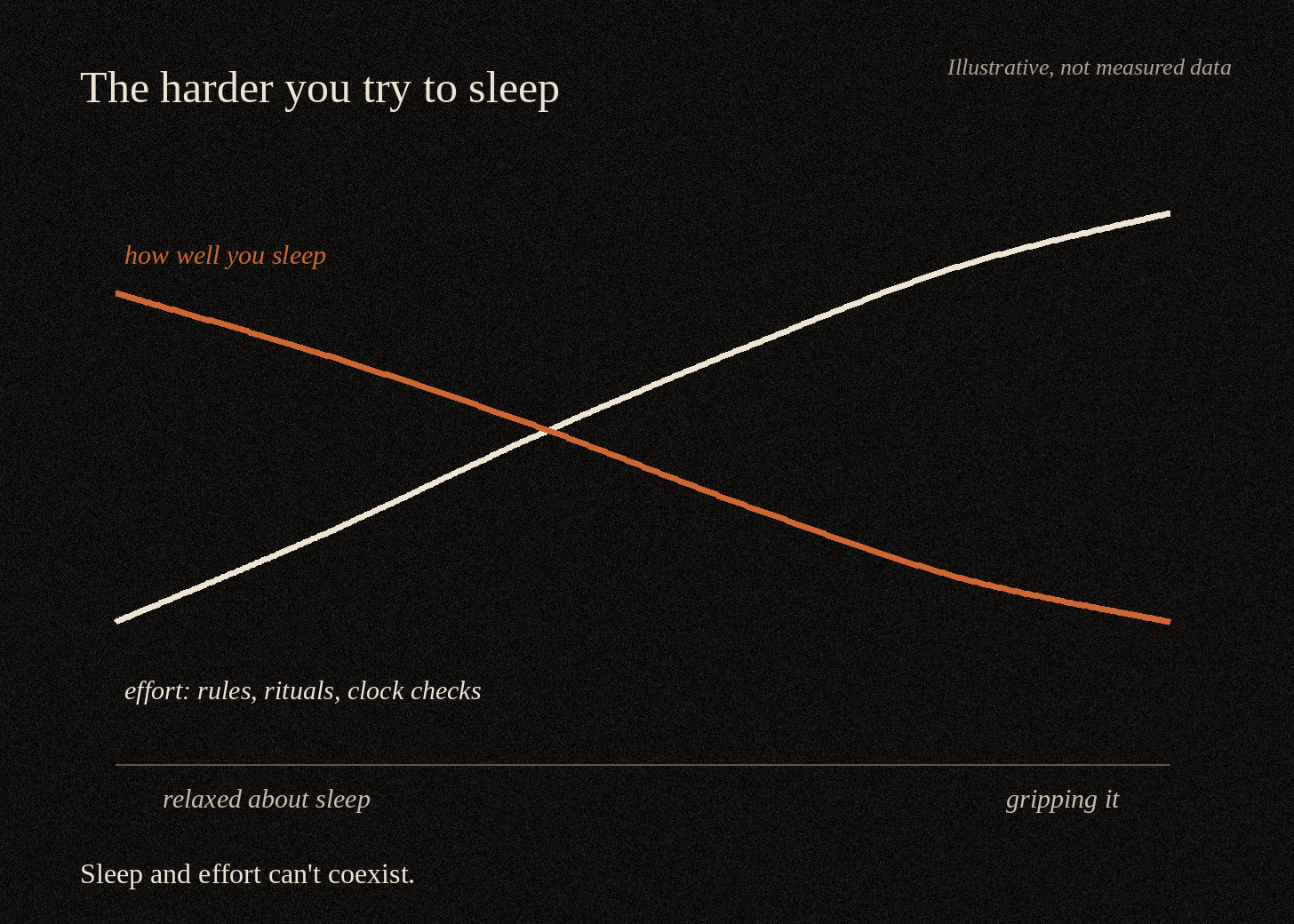
First question I ask anyone with broken sleep: “Does it feel like the harder you try to sleep, the worse it gets?”
The answer is always YES.
Why?
Because sleep and effort can’t coexist.
Sleep only comes when your nervous system stands down from alert. Trying IS alert.
Checking the clock, counting the hours left, reminding yourself you need eight for tomorrow’s meeting... each one tells your brain there’s a problem to solve, so it stays on watch.
It’s like gripping sand. The tighter you squeeze, the faster it runs through your fingers.
And the rigidity makes it worse. In bed by 10 to hit 8 hours. Supplements in the right order, mouth tape on, a score to beat by morning... a rigid ritual is still effort, just dressed up as recovery.
What I find with high performers is that they bring the same approach to sleep that works everywhere else in their life.
Set the target.
Measure it.
Push harder when it slips.
That’s a brilliant way to run a company. It’s a terrible way to fall asleep.
So the bad night becomes a problem to solve. The next night carries the pressure of the last one. By the third or fourth, a man is dreading bed before dinner’s even finished, and that dread is waiting for him on the pillow.
It’s the same reason a man who’s had one bad night before a big pitch often has a worse one before the next. Nothing about his body changed. The expectation did.
That’s the grip. And no supplement on earth loosens it.
Why I can say this
I know both of these from the inside.
At 20, I gave myself atrial fibrillation. For years afterward I was on edge, hypervigilant, stuck in fight or flight.
So I did what driven men do. I tried to make myself safe by watching more closely and adding more.
I took a supplement stack on and off for about fifteen years. I skipped breakfast for 2 years after The Circadian Code convinced me it was the smart move. I wore a Whoop for 18 months and checked my sleep score every morning before I’d checked in with how I actually felt.
I was running the bill and the grip at the same time.
My sleep improved after I took the Whoop off. I’d stopped standing guard over my own sleep.
Take things away
This is where most men expect the new list of things to add. There isn’t one.
Calibration is subtraction. You take the interference away and let a system that already works do its job.
Start with the day.
Food before coffee, and before you train.
Laptop closed when the kids go down.
Overhead lights down after dinner.
Then the night, and this is the part that matters most.
Let being awake be fine.
Not gritting your teeth through it. Genuinely fine with it. If you’re lying there warm and resting, your body is still recovering. Nothing is going wrong.
Drop the rules like having no set bedtime and don’t get into bed unless you’re genuinely struggling to keep your eyes open.
No clock in view. If you wake at 3am, don’t check the time. Get out of bed and either read something enjoyable or do some fascia release using a fascia ball or Theracane (get into your body, not your mind!).
And fill the time before bed with something you actually enjoy, not something you’re doing for your sleep.
That might be some fascia release or ten minutes on a foam roller, so you get out of your head and into your body. It might be a book. It might be something funny on TV that makes you laugh out loud. It might be time with your wife that has nothing to do with tomorrow’s meeting.
The less you think about sleep, and the more you think about enjoying your evening (or the person you’re spending it with), the more easily sleep comes.
I know it sounds backwards. That’s exactly why it works.
So do you still need the magnesium?
Give it a few weeks. Take the interference out of the day, take the effort out of the night, and see where your sleep lands.
If you still want the magnesium after that, that’s fine. Take it.
My guess is you’ll find you don’t need it. And you’ll get something better than a good sleep score: you’ll start feeling the way you want to feel again, in the boardroom and at home.
Which one sounds like you? Comment the letter below:
A. I fall asleep fine but wake around 3am, mind running
B. My day starts early with coffee and training before food
C. The harder I try to sleep, the worse it gets
I’ll reply with what I think is going on for your version, and why.
For A, what that 3am wake is usually trying to tell you. For B, what the first hours of your day are likely costing your nights. For C, why the trying keeps you awake. One letter is enough.
Rather keep it private? DM me the letter instead. You’ll get the same answer, and it stays between you and me.
That’s it. Thanks for reading. If it didn’t add value, feel free to comment below and tell me why, or if you’d prefer to keep it private, send me a DM.
Otherwise, see you next time.
Simmo.

P.S. I’m a health coach, not a doctor, dietitian or licensed healthcare professional. This is general education, not medical advice, and no coaching or medical relationship is created by reading, commenting or messaging me. Talk to your doctor before changing your diet, sleep, training or supplements, and never start, stop or change medication, including sleep medication, based on this. If you snore heavily, wake up gasping, or have chest pain, fainting or an irregular heartbeat, seek medical care promptly.
A