


There is one health habit almost every executive I work with treats as beyond question.
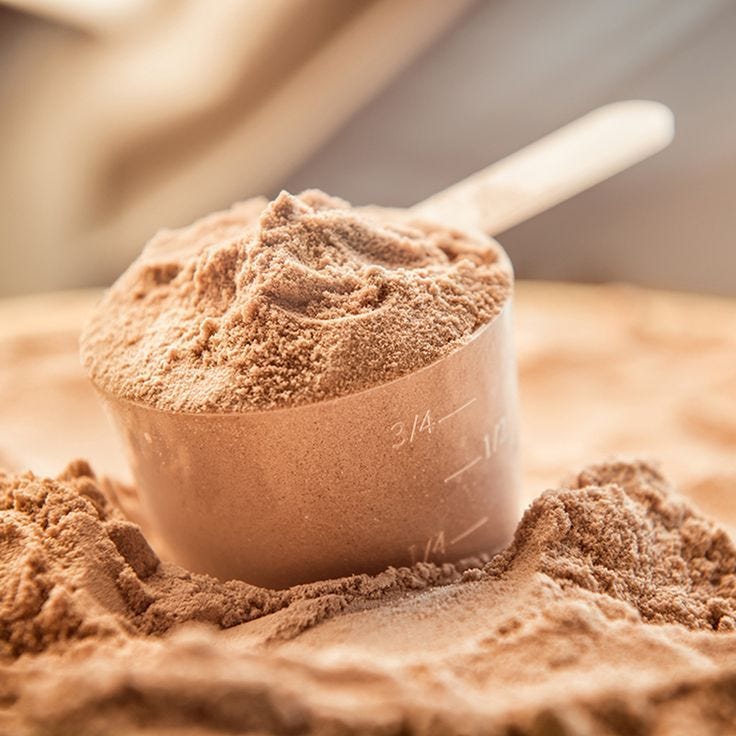
The morning protein shake.
Whatever else is up for debate, the shake is sacred. It is the one box he is sure he is checking correctly.
“Getting my protein in,” he says, in the tone of a man repeating something he stopped examining a long time ago.
I want to take that one apart, because it is a near-perfect example of how the optimization world operates. It finds a real but narrow need, manufactures a shortage of it, sells you the fix, and lets you feel diligent while the actual problems sit untouched in the corner.
You can feel the wave he is riding. Protein is having its moment. Every feed is full of it, the high-protein this and the thirty-grams-per-serving that, the candy bars and breads and bottled waters all reformulated to shout their protein content from the box.
A whole culture has quietly decided that more protein is self-evidently better, the same way it once decided that about low fat, and about ten thousand steps. The shake is the daily sacrament of that faith, and like every faith it asks you to keep performing the ritual and never check whether the thing it promised was real in the first place.
Let me say the unpopular part first, since the internet has lately gone the other way and started calling whey poison.
Whey is not toxic.
That backlash is as overcooked as the hype it replaced. The problem with your shake is not that it is dangerous. The problem is that you are using a tool built to fix protein deficiency, and you are almost certainly not protein deficient.
You are solving a problem you do not have, with real focus, while the ones you do have go unaddressed.
You are not deficient
Start with the number everyone has been trained to feel anxious about.
The official requirement for protein is roughly 0.8-1 gram per pound of body weight, and that figure was deliberately set higher than the measured average need, specifically so it would cover nearly everyone.
Most adults in developed countries clear it without trying. American men between nineteen and fifty-nine, which is the bracket most of my clients live in, on average eat more protein than recommended, not less.
The typical person already gets around sixteen percent of his calories from protein when the requirement sits closer to ten.
So the deficiency the entire protein industry is built on does not exist for most of the people buying the product. And the target has been inflated on top of that. The number floating around the gyms and the feeds, a gram of protein per pound of bodyweight, is roughly triple the actual requirement and sits well above what even hard-training athletes need.
You did not arrive at that figure by reading the research. You absorbed it from an industry with a reason to inflate it.
I want to be careful with that claim, because the lazy version is a conspiracy, and it does not need to be one. It is simpler and worse than that. It is incentive. A business that sells protein profits from every gram you believe you are missing, so it funds the studies, pays the influencers, and buys the marketing that moves the bar higher and keeps you anxious about a shortage you do not have. Nobody had to plot it.
The money flows toward the message that sells more powder, and over time that message becomes the thing everyone “knows.”
You were sold a shortage, then sold a target three times larger than it, because “more protein” is the easiest, most virtuous-feeling resolution a man can make. Nobody ever felt guilty buying protein, which is exactly what makes it such a good thing to sell you.
The honest exceptions
Now I have to be fair, because there is a real version of this story and a sharp reader will raise it before I do.
More protein than the bare minimum genuinely helps some people. Older men, whose bodies get worse at using protein and begin shedding muscle, do better eating more than the standard recommendation.
People in a fat-loss phase hold onto more muscle when protein is higher. And men who train hard against real resistance benefit somewhere around twice the baseline figure. If you are in one of those groups, more protein is not marketing. It is useful, and I would tell you to eat more of it.
But follow it through, because this is the step the powder companies hope you skip. If you are training hard, you are also eating more food, and more food drags more protein along with it. If you are an older man defending his muscle, a few palm-sized portions of real food spread across the day does the job. The need for more protein, where it is real, is almost never a need for a powder. It is a need for more food, or better-timed food.
The shake solves one specific problem, getting protein into you without eating, and almost nobody actually has that problem. You have a kitchen and three meals.
Whey is fine. It is just not magic.
Let me tell you what whey actually is, because most people drinking it have no idea.
It is the watery liquid left behind when milk is curdled into cheese. For most of history it was a nuisance, a disposal problem that cheesemakers drained off and poured out or fed to the pigs.
The quiet genius of the modern supplement industry was to take that leftover, dry it into a powder, and sell it back to you at a premium as a performance food.
Your daily shake is, in plain terms, repurposed cheesemaking runoff with a marketing budget behind it. That is not an attack on whey. It is a fine, safe, genuinely useful protein. It is an attack on the price and the reverence, both of which were manufactured.
And it is safe, despite the headlines. Heavy metals do turn up in protein powders, because the category is unregulated, and one round of independent testing found nearly half of the products on the market sitting over a conservative limit for things like lead, cadmium, and arsenic.
But here is the part the fear-sellers leave out:
(animal derived) Whey was among the cleanest options tested.
The worst offenders, by a wide margin, were the plant-based powders sold as the healthier choice, because plants draw heavy metals up out of the soil while a cow filters most of them out first. The contamination is real, but it is a story about a dirty, unregulated industry, and whey sits at the clean end of it.
So if you use a powder, pick one that is third-party tested, and drop the idea that whey itself is the poison. Reaching for that points the finger at the cleanest thing on the shelf, and it makes you sound like exactly the fear-seller a careful man learns to tune out.
But “not toxic” is a very different claim from “necessary,” and different again from “better than food.” A shake is protein with the food removed. Whole protein arrives wrapped in everything the powder strips away. The chewing and the fullness that signal to your body that you have actually eaten.
The other nutrients that ride along with real meat, fish, eggs, and raw dairy (consumed at room temperate). The plain fact that a meal is a meal, while a shake is a habit you barely register performing. When you reach past the eggs for the powder, you are not trading up. You are trading down and paying for the privilege, because the powder is convenient, and the marketing taught you to read convenient as optimal.
There is also a ceiling almost everyone ignores. Past the point that fully supports your muscle, more protein does not build more muscle. Your body does not store the surplus. It burns it for energy. The third scoop is not extra insurance. It is expensive fuel you did not need, sitting where real food should have been.
How to know if you actually need more
If you want to cut through the noise, here are the only questions that matter, and none of them is answered by a tub.
Are you over sixty, or losing weight on purpose, or training hard enough to be sore and progressing? If none of those is a clear yes, your protein need is ordinary, and you almost certainly already meet it.
Are you eating real protein at most meals? A palm of meat, fish, eggs, dairy, or raw cheese (at room temperature) per meal is plenty for most people. If the answer is yes, there is no gap for a shake to fill.
When you fall short, is it a food problem or a protein problem? Nine times out of ten it is that you skipped a real meal, not that you need a supplement. Fix the meal.
If you went through those honestly and came out needing more, eat more food first. The powder is the last resort, not the default, and certainly not the centerpiece.
What the shake is actually hiding
Here is why I bother taking apart something this small. The shake is not the problem. The shake is the decoy.
The man drinking it does not have a protein deficiency. He has other problems, real ones, and the shake lets him sidestep all of them while feeling productive. He has a food-quality problem, a diet built increasingly out of convenient processed things, of which the shake is simply one more. He has a total-intake or a meal-rhythm problem, eating too little real food across the day and trying to patch the hole with a drink.
He may have a training problem, because muscle is built by the stimulus of hard training and the recovery that follows it, not by pouring in protein past the point of sufficiency. And underneath all of it he usually has the same condition every optimizer has. He would rather add one more thing than fix the harder things already on the table.
The shake is the easiest possible box to check, and that is precisely why it is the wrong one to fixate on. It lets a busy, anxious, high-performing man feel like he has handled his nutrition while the real levers, the quality of his food, the rhythm of his eating, the training, the sleep that all his recovery depends on, go untouched. It is addition standing in for the harder work of subtraction and quality. It is motion that feels like progress.
The calibration
The protein shake is a small lever that has been sold to you as a foundation. It is the new multivitamin. A supplement marketed as essential, bought largely by people who were already covered, consumed mostly to quiet the background hum of worry that you are not doing enough.
Whey is not your enemy. The belief that you need it is. If you are older, or dieting, or training seriously, then eat more protein, get it from food first, and treat the shake as the occasional genuine convenience it is, for the day the kitchen loses, not the keystone of your diet. And if you are like most of the men reading this, neither old nor cutting nor training like an athlete, then the honest truth is that your morning shake is doing almost nothing, beyond making a problem you do not have feel handled.
You do not have a protein problem. You have a doing-more-instead-of-doing-better problem, and the shake is a monument to it. Put it down, fix the food underneath it, and notice how little you actually miss it.
This newsletter is where I take one of these apart every week. The habits you are sure are helping, the shortages someone manufactured so they could sell you the fix, the additions quietly standing in for the harder subtractions. Subscribe if that is useful to you. Don’t if it isn’t.

P.S. None of this is medical advice. If you are older, recovering from illness, or working with a clinician on muscle loss, higher protein genuinely matters for you, and a shake can be a sensible tool to reach it. Whey is safe. If you use it, choose a third-party tested brand. The argument here is not that whey is bad. It is that for most people it is answering a question their body never asked.
I'm always intrigued when I see protein requirement in grams (protein) per pound (bodyweight).